Friday, September 28, 2018
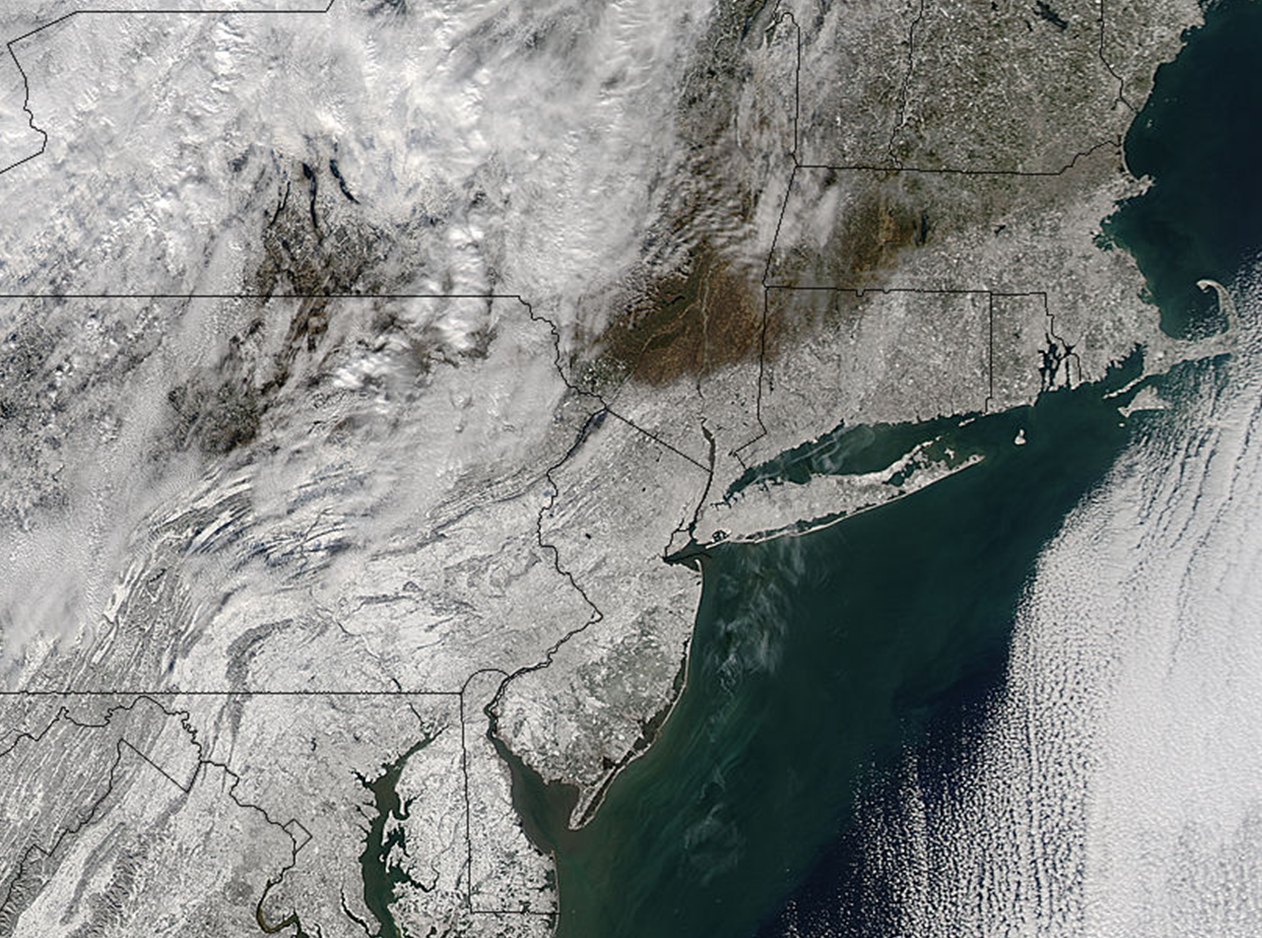
January 22-24, 2016 Blizzard
The Blizzard of 2016, known as Snowzilla or Winter Storm Jonas, delivered many inches of snow in the Northeast United States and the Mid-Atlantic. Specifically, Newark, NJ received about 2 feet of snow. Snowzilla caused more than 30 deaths, due to car accidents, hypothermia, heart attacks while shoveling snow, and carbon-monoxide poisoning from clogged exhaust pipes from snow. There was about $600 million to $300 billion worth of property damage and 630,000+ power outages for multiple days. Once the snow melted, the flooding was considered worse than Storm Sandy. The National Weather Service describes a blizzard by its duration, wind speeds, and the reduction in visibility. Another blizzard in 1996 was compared to the Snowzilla because of its similar damage costs, the death toll in NJ, snowfall, and impacted states.

Thursday, September 20, 2018
Lewis Fry Richardson
Lewis Fry Richardson
Lewis Fry Richardson was born on October 11 of the year 1881, to a quaker family in England. Both his parents, Catherine Fry and David Richardson, partook in the field of business. His parent's circumstances allowed Lewis to attend some of the most prestigious schools; this includes Newcastle Preparatory, Bootham School, Durham College of Science, and King's College, Cambridge. His influences in these various schools allowed Lewis to acquire a strong foundation in numerous fields of science. One influence in particular gave Lewis the drive to learn about meteorology; an encounter with a man named J Edmund Clark, due to his expertise in meteorology.
Lewis was not a man of single focus, for he has knowledge in many subjects. In fact, Lewis is a mathematician and a physicist. Having the experience in these fields allowed him to construct a goal: making weather forecast predictions based on mathematical algorithms. There, however, was one factor that quelled his process to proceed with his idea and that was the first World War, where he served as an ambulance driver in Europe.

This did not stop him, after his service he returned back to the lab to hand write equations based on the data he collected with his experiments. At Benson he looked at clouds and rain by using thermodynamics and radiation. He wrote a book on his finds that included every algorithm he solved. Another scientist disagreed with his work, but later on in 1993 a scientist named Lynch showed that Lewis's calculations had few errors and stated that it was "impressive" since he did everything by hand. He later had an idea to create a company that would be able to produce weather predictions around the clock. This was called the Forecast Factory, which included 65,000 people, each focusing on a section of the globe and figuring out the weather in that area. This was equivalent to using 100,000 super computers with powerful processing units.

(Random Data Base Center)
(Lewis Fry Richardson)

Sunday, September 16, 2018
Guy Stewart Callendar, born February 8, 1898 in Montreal, is the reason that climate change is at the forefront of science research today. While he most contributed towards civilian and military advancements as a steam engineer and and inventor, he is also accredited for coming up with the "Calendar Effect"/"Greenhouse Effect". Callendar, through intense data analysis, found a direct correlation between the rising levels of CO2 in the atmosphere and and the rising temperatures of Earth's surface. This rather simplistic discovery would eventually lead to all of global warming research. In 1938, Callendar published his works but as novice Meteorologist his findings were completely ignored. It wasn't for a few decades until scientists started to seriously look at the "Callendar Effect". Charles David Keeling verified the work in 1958 putting climate change research to the forefront. Today approximately $30 Billion are spent every year on climate change research and global warming prevention programs. We have come a long way since the work of Guy Stewart Callendar and still have a ways to go before solving the issue.


Friday, September 14, 2018
Delta Flight 191
Delta flight 191 can/should be considered one of the most devastating crashes of all time because this crash resulted in 137 people dying and leaving 28 more injured. The plane was on its way to Dallas-Fort Worth airport from Fort Lauderdale airport before it crashed. The plane crashed because as it was flying through a dark cloud it was pushed by a microburst (an intense small-scale downdraft produced by a thunderstorm or rain shower) and thrown off it's intended flight path. The plane then ended up crashing into a car on a highway in Texas and also crashed into two water tanks. The plane started to burn and began to split apart near the runway at Dallas-Fort Worth airport.
This all happened because the two pilots of the aircraft decided to fly through a storm instead of just delaying or even canceling the flight. The plane was also unable to detect the microburst because the radar equipment was broken. The F.A.A has now made a law stating that no flights are allowed to takeoff or land if there is a storm so that nothing like this ever happens again. In Conclusion Delta Flight 191 was a devastating event but because of it the Aviation industry has now taken a more serious approach on the safeness of the aircraft as well as the people inside of the aircraft and this will help make flying safe again.
Thursday, December 14, 2017
Climate Change in Modern Times
Climate change is a phenomenon that has been present on earth for ages. In the distant past, it was driven heavily by natural sources, such as volcanic eruptions or changes in the earth's orbit. In modern times though, climate change is driven primarily by anthropogenic, or human-originating, sources.
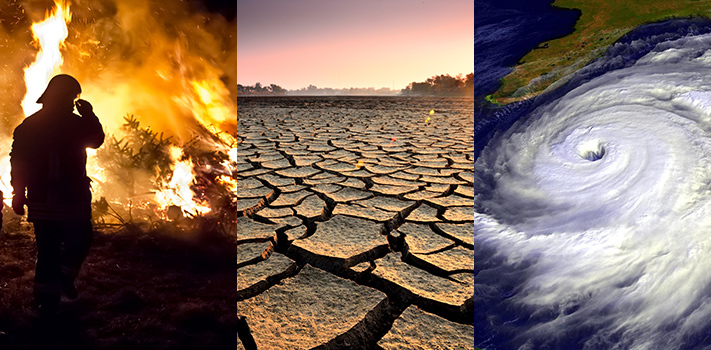
Currently, the biggest contributor to anthropogenic climate change is the expansion of the greenhouse effect. This expansion is being driven primarily by the buildup of carbon dioxide in the atmosphere. Although carbon dioxide is less abundant in the atmosphere than water vapor (which is the most abundant greenhouse gas), it stands out in many ways: it has a higher radiative forcing than water vapor, a long life cycle, and it is by far the most common greenhouse gas that results from human activity. Human activity does not appear to be going downhill; instead, it is only increasing as the population also increases. This means that not only will carbon dioxide continue to be thrown into the atmosphere, but it will also be thrown in greater amounts.
There are many ways in which carbon dioxide is put into the atmosphere by humans. Common examples include deforestation, the burning of fossil fuels, car exhaust, and much more.
Deforestation occurs regularly. As the population increases so do the demands for housing and changing of lands. Trees are cut down to meet these demands. Trees release carbon dioxide they had absorbed prior to their cutting down when they are cut down. Diminishing the number of trees also lowers the amount of carbon dioxide absorbed by trees, therefore allowing more carbon dioxide to stay in the atmosphere. Essentially, when trees are cut down, the carbon cycle is being disturbed.
So what is the buildup of carbon dioxide leading to? As stated before, it is leading to an expansion of the greenhouse effect, and the expansion of the greenhouse effect is leading to climate change. Climate change's effects can be seen everywhere, and the biggest effect of climate change is global warming. Global warming is responsible for the melting of polar ice caps, increase in dire-weather events, floods, droughts, rising sea-levels, and much more, harming both humans and animals.
So what can be done to eliminate climate change?
At this point, not much. Greenhouse gases have such long life cycles, and even if the whole earth were to stop moving (i.e. no human activity) carbon dioxide and other greenhouse gases would continue to have their heating effect on the atmosphere for a very long time.
Nonetheless, climate change can be combatted in the following ways: awareness and adaptation.
Awareness is important because when more people work for a cause, more happens. The more people know about climate change, the better. Adaptation is important because we cannot reverse climate change at this point as explained above. So we must learn to live with it, finding ways around the problems that it will continue impose on us.
Remote Sensing: Weather Satellites
Remote sensing is defined as the science of identifying, observing, and measuring an object without coming into direct contact with it. Remote Sensing originated when photography came about. It was going on for a while until it was first introduced in 1960 by Evelyn L. Pruitt of the U.S. Office of Naval Research. A satellite would detect and measure radiation of different wavelengths reflected or emitted from distant objects or materials. This data is sent to earth and computer systems translate it to an image.
Types of Remote Sensing:
Passive instruments only perceive radiation that is detected by natural energy.
Active instruments come with their own sources of EM energy and therefore are able to give light to the object of focus.
A satellite is a moon, planet or machine that orbits a planet or star. There are many types of satellites that are used to provide data for forecasting. Meteorologists use visible satellite images, infrared satellite images, and water vapor satellite images the most.
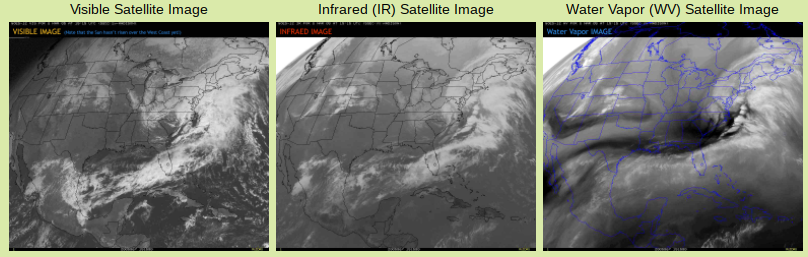
Satellites are designed in a complex manner but they all share an antenna and a power source. To collect data to forecast the weather, meteorologists would mainly focus on the two main types of satellites: GOES and POES.
 - GOES stands for Geostationary Operational Environmental Satellite and they orbit the earth above its equator at an altitude about 36,000 km high.
-POES orbit at a lower altitude of about 850 km high and take an estimate of 100 minutes to travel from pole to pole.
Satellites are proven to save lives. COSPAS-SARSAT has been acknowledged for rescuing more than 27,000 lives
Types of Remote Sensing:
Passive instruments only perceive radiation that is detected by natural energy.
Active instruments come with their own sources of EM energy and therefore are able to give light to the object of focus.
A satellite is a moon, planet or machine that orbits a planet or star. There are many types of satellites that are used to provide data for forecasting. Meteorologists use visible satellite images, infrared satellite images, and water vapor satellite images the most.
Satellites are designed in a complex manner but they all share an antenna and a power source. To collect data to forecast the weather, meteorologists would mainly focus on the two main types of satellites: GOES and POES.
- GOES stands for Geostationary Operational Environmental Satellite and they orbit the earth above its equator at an altitude about 36,000 km high.-POES orbit at a lower altitude of about 850 km high and take an estimate of 100 minutes to travel from pole to pole.
Satellites are proven to save lives. COSPAS-SARSAT has been acknowledged for rescuing more than 27,000 lives
Wednesday, December 13, 2017
1931 China Floods
The 1931 China floods can be considered the deadliest natural disasters. 52 million people were affected by the floods. You can not even tally up the amount of damage that happened that occurred in central China. You also can not tally up the amount of deaths that are caused by his storm. Over 4 million died because of the flood and this is a loose approximation. The weather leading up to the flood was unusual. They had a severe drought from 1928-1930 and than an abnormally cold winter with heavy snow. In the summer of they experienced 7 cyclones, the normal amount is two per year.
Then the dams and dykes were abused and weak because the government was disorganized from constant attempts of evasion from the Japanese and internally there was not a established government. So the weak dykes and dams were not able to contain the sudden increase in water levels and broke. All of central China was flooded. The inundations were constant and wiped out all of China's crops. Many people died because of disease and famine then the inundations itself. The situation was so bad that people resorted to cannibalism for food. It took many years for China to recover from this horrific event. China didn't build a complete dam until 2009. This was because the rivers kept breaking the dams and dykes. The 1931 China floods show us we need to be prepared for disasters and we need to keep track of our environment.

Then the dams and dykes were abused and weak because the government was disorganized from constant attempts of evasion from the Japanese and internally there was not a established government. So the weak dykes and dams were not able to contain the sudden increase in water levels and broke. All of central China was flooded. The inundations were constant and wiped out all of China's crops. Many people died because of disease and famine then the inundations itself. The situation was so bad that people resorted to cannibalism for food. It took many years for China to recover from this horrific event. China didn't build a complete dam until 2009. This was because the rivers kept breaking the dams and dykes. The 1931 China floods show us we need to be prepared for disasters and we need to keep track of our environment.
Subscribe to:
Posts (Atom)